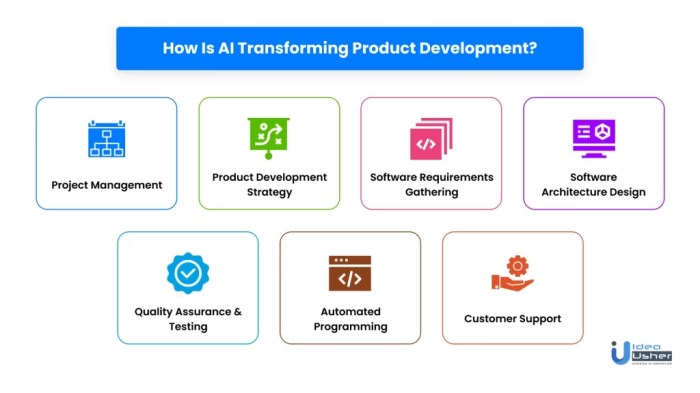
The integration of artificial intelligence (AI) is rapidly transforming product development, ushering in an era of unprecedented innovation. From initial concept generation to post-launch analysis, AI’s influence is pervasive, streamlining processes, enhancing efficiency, and ultimately, delivering superior products that better meet consumer needs. This exploration delves into the multifaceted ways AI is reshaping the product lifecycle, examining both its transformative potential and its inherent challenges.
We will explore how AI algorithms facilitate creative ideation, analyze market trends with unparalleled accuracy, and optimize manufacturing processes for maximum efficiency. Furthermore, we will consider the ethical implications of AI integration, emphasizing the importance of responsible development and deployment. Ultimately, this examination aims to provide a comprehensive understanding of AI’s impact on the future of product innovation.
Defining AI’s Role in Product Innovation
Artificial intelligence (AI) is rapidly transforming the landscape of product development, moving beyond simple automation to become a strategic partner in driving innovation. Its capabilities are reshaping how companies conceive, design, manufacture, and market their products, leading to faster time-to-market, improved product quality, and enhanced customer experiences.
AI’s Applications in Product Development Processes
AI enhances product development through various applications. Machine learning algorithms analyze vast datasets of customer preferences, market trends, and competitor activities to identify unmet needs and opportunities for innovation. AI-powered design tools allow for rapid prototyping and simulation, enabling engineers to explore numerous design iterations and optimize product performance. Predictive analytics help forecast demand and manage supply chains more effectively.
Natural language processing (NLP) facilitates efficient communication and collaboration among diverse teams involved in the product development process. Computer vision systems are used in quality control, automating defect detection and ensuring consistent product quality.
AI’s Impact Across the Product Lifecycle
AI’s influence spans all stages of the product lifecycle. During the ideation phase, AI algorithms can generate novel product concepts based on identified market gaps and customer needs. In the design phase, AI-powered tools assist in optimizing product design for functionality, aesthetics, and manufacturability. During manufacturing, AI can optimize production processes, predict potential equipment failures, and improve overall efficiency.
In the marketing and sales phase, AI-driven personalization engines tailor marketing campaigns and customer interactions, leading to improved conversion rates. Finally, post-launch, AI facilitates continuous product improvement through data analysis and feedback mechanisms, enabling companies to adapt to changing customer needs and market dynamics. For example, Netflix utilizes AI to recommend content, personalize user interfaces, and improve its algorithm for better content delivery.
Comparison of Traditional and AI-Driven Product Development
Traditional product development methodologies often rely on iterative cycles of design, testing, and refinement, heavily reliant on human expertise and intuition. This can be a time-consuming and resource-intensive process. In contrast, AI-driven approaches leverage data-driven insights and automation to accelerate the development process. AI can analyze vast amounts of data to identify trends and patterns that humans might miss, leading to more informed decisions and faster iterations.
While traditional methods excel in capturing nuanced aspects of human experience, AI excels in handling large datasets and automating repetitive tasks, offering a complementary approach.
Advantages and Disadvantages of AI in Product Innovation
| Advantages | Disadvantages |
|---|---|
| Increased speed and efficiency in development | High initial investment costs in AI infrastructure and expertise |
| Improved product quality and performance | Potential for bias in algorithms and data, leading to unfair or inaccurate outcomes |
| Enhanced customer experience through personalization | Concerns about data privacy and security |
| Data-driven decision making leading to reduced risk | Dependence on data availability and quality; lack of explainability in some AI models |
AI in Prototyping and Testing
AI is rapidly transforming the prototyping and testing phases of product development, offering significant improvements in speed, efficiency, and accuracy. By leveraging machine learning and simulation techniques, companies can drastically reduce development time and costs while enhancing product quality and user experience. This section explores the specific applications of AI in these crucial stages of the product lifecycle.AI’s ability to rapidly generate and simulate numerous design iterations allows for a more comprehensive exploration of the design space than traditional methods.
This results in prototypes that are better optimized for performance, cost-effectiveness, and user satisfaction. Furthermore, AI-powered analysis tools can identify subtle flaws or areas for improvement that might be missed by human eyes, leading to more robust and reliable final products.
AI in Rapid Prototyping and Simulation
AI algorithms, particularly generative design tools, can create multiple design variations based on specified parameters and constraints. These tools explore a vast design space far exceeding human capabilities, leading to innovative and often unexpected solutions. For example, in automotive design, AI can generate numerous chassis designs optimized for weight, strength, and crash safety, significantly reducing the time and effort required for manual design iterations.
Simulation software, enhanced by AI, can accurately predict the performance of these prototypes under various conditions, further refining the design before physical prototypes are even built. This reduces reliance on expensive and time-consuming physical testing.
AI-Driven Prototype Performance Analysis
AI can analyze large datasets generated during simulations or physical testing of prototypes. Machine learning models can identify patterns and correlations that are difficult for humans to detect, revealing potential weaknesses or areas for improvement in the design. For instance, AI can analyze stress distribution data from finite element analysis (FEA) simulations to pinpoint stress concentrations that could lead to failure.
Similarly, AI can analyze user feedback data from usability testing to identify areas where the user interface could be improved. This data-driven approach allows for more targeted design iterations, leading to a faster and more efficient development process.
Incorporating AI-Driven Testing into a Product Development Workflow
A step-by-step procedure for integrating AI-driven testing into a product development workflow might look like this:
- Define Testing Objectives: Clearly articulate the goals of the testing process, specifying the performance metrics to be evaluated and the acceptable thresholds.
- Data Acquisition: Gather relevant data from simulations, physical testing, or user feedback. This data should be appropriately cleaned and preprocessed for AI analysis.
- AI Model Selection: Choose appropriate machine learning algorithms based on the type of data and the testing objectives. This might involve regression models for predicting performance metrics or classification models for identifying defects.
- Model Training and Validation: Train the chosen AI model on the collected data and validate its performance using a separate test dataset. This ensures the model’s accuracy and reliability.
- Prototype Analysis: Use the trained AI model to analyze the performance of the prototype and identify areas for improvement. This might involve generating reports highlighting potential weaknesses or suggesting design modifications.
- Iteration and Refinement: Based on the AI-driven analysis, iterate on the prototype design and repeat the testing process until the desired performance levels are achieved.
Accelerating the Feedback Loop in Prototyping with AI
- Automated testing: AI can automate repetitive testing tasks, such as running simulations or analyzing test results, freeing up engineers to focus on more complex design challenges.
- Faster iteration cycles: AI-driven analysis allows for quicker identification of design flaws, leading to faster iteration cycles and reduced development time.
- Improved design decisions: AI can provide data-driven insights that inform design decisions, leading to more robust and reliable products.
- Reduced reliance on physical prototypes: AI-powered simulations can reduce the need for expensive and time-consuming physical prototypes.
- Enhanced collaboration: AI tools can facilitate better communication and collaboration between engineers, designers, and other stakeholders.
AI’s Influence on Production and Manufacturing
The integration of artificial intelligence (AI) is revolutionizing production and manufacturing, driving significant improvements in efficiency, cost reduction, and overall quality. AI’s ability to analyze vast datasets, identify patterns, and make predictions allows for unprecedented levels of optimization across the entire manufacturing lifecycle. This leads to smarter, more responsive, and ultimately more profitable operations.AI optimizes manufacturing processes through various techniques, leading to enhanced efficiency and reduced costs.
This involves analyzing real-time data from machines and processes to identify bottlenecks, predict potential failures, and optimize resource allocation. For instance, AI-powered scheduling systems can dynamically adjust production schedules based on real-time demand and resource availability, minimizing downtime and maximizing throughput. Similarly, AI algorithms can optimize material usage, reducing waste and lowering material costs.
AI in Predictive Maintenance and Quality Control
Predictive maintenance, powered by AI, utilizes machine learning algorithms to analyze sensor data from equipment to predict potential failures before they occur. This allows for proactive maintenance, minimizing costly downtime and extending the lifespan of machinery. For example, by analyzing vibration patterns and temperature readings from a production line, an AI system can predict the imminent failure of a specific component, allowing for its timely replacement before it causes a production halt.
Similarly, AI plays a crucial role in quality control by analyzing images and sensor data to identify defects in real-time, ensuring that only high-quality products leave the factory. This reduces the need for extensive manual inspections and minimizes the risk of shipping defective products.
AI in Different Manufacturing Sectors
The application of AI varies across different manufacturing sectors, tailored to their specific needs and challenges. In the automotive industry, AI is used extensively in robotics for assembly line automation, predictive maintenance of complex machinery, and quality control of intricate components. The electronics sector leverages AI for optimizing chip manufacturing processes, improving yield rates, and ensuring the quality of electronic components.
Other sectors, such as pharmaceuticals and food processing, also benefit from AI’s capabilities in areas like process optimization, predictive maintenance, and quality assurance. The adaptation of AI is not a one-size-fits-all solution; instead, it’s a tailored approach that maximizes the specific advantages offered by AI in each industry.
Comparison of Traditional and AI-Driven Manufacturing Techniques
| Feature | Traditional Manufacturing | AI-Driven Manufacturing |
|---|---|---|
| Process Optimization | Relies on historical data and expert knowledge; often reactive. | Utilizes real-time data analysis and machine learning for proactive optimization. |
| Predictive Maintenance | Scheduled maintenance based on time or usage; prone to unexpected downtime. | Predictive maintenance based on data analysis, minimizing downtime and maximizing equipment lifespan. |
| Quality Control | Primarily manual inspection, prone to human error and inefficiency. | Automated quality control using AI-powered vision systems and data analysis for real-time defect detection. |
| Cost Efficiency | Higher operational costs due to downtime, waste, and manual labor. | Lower operational costs due to reduced downtime, waste minimization, and automation. |
AI and the Product Launch Process
The product launch phase is critical for success, and AI is rapidly transforming how companies approach this crucial period. By leveraging AI’s capabilities in data analysis, prediction, and automation, businesses can significantly enhance their chances of a successful product launch and maximize return on investment. This involves streamlining various aspects, from pre-launch marketing to post-launch customer engagement and product lifecycle management.AI significantly impacts the effectiveness and efficiency of the product launch process.
Through sophisticated algorithms and machine learning models, businesses can gain valuable insights, personalize customer interactions, and optimize resource allocation to achieve optimal results.
AI-Powered Personalization of Marketing Campaigns
AI allows for hyper-personalized marketing campaigns tailored to individual customer segments. By analyzing vast amounts of customer data, including demographics, purchase history, browsing behavior, and social media activity, AI algorithms can identify specific customer needs and preferences. This data allows marketers to create targeted advertising messages, email campaigns, and social media content that resonate with individual customers, increasing engagement and conversion rates.
For example, a clothing retailer might use AI to segment customers based on style preferences and then deliver personalized product recommendations and promotional offers through email or social media channels. This approach is far more effective than generic marketing blasts.
AI-Driven Demand Prediction and Inventory Optimization
Accurate demand forecasting is crucial for successful product launches. AI algorithms, particularly those based on machine learning and deep learning, can analyze historical sales data, market trends, economic indicators, and social media sentiment to predict future demand with greater accuracy than traditional methods. This allows companies to optimize their inventory levels, reducing the risk of stockouts or excess inventory. For instance, a company launching a new smartphone might use AI to predict demand based on pre-orders, social media buzz, and comparisons to similar products.
This would allow them to accurately order components and ensure sufficient units are available at launch, minimizing potential lost sales.
AI-Powered Post-Launch Customer Feedback Analysis
Post-launch customer feedback is invaluable for improving products and services. AI-powered tools can automate the process of collecting, analyzing, and interpreting customer feedback from various sources, including online reviews, social media comments, customer surveys, and support tickets. Natural Language Processing (NLP) algorithms can analyze textual data to identify key themes, sentiments, and areas for improvement. For example, a software company might use AI to analyze user reviews on app stores to identify bugs, usability issues, and feature requests.
This allows them to prioritize bug fixes and plan future product updates based on direct customer feedback. Sentiment analysis can also identify overall customer satisfaction levels, allowing for proactive responses to negative feedback.
AI in Managing Product Lifecycle and Updates
AI’s role extends beyond the initial launch. It plays a crucial role in managing the product lifecycle and planning for future updates and iterations. By continuously monitoring customer feedback, market trends, and competitive landscape, AI can identify opportunities for product improvements and new feature development. This allows companies to stay ahead of the curve, enhancing customer satisfaction and maintaining a competitive edge.
For example, a video game developer might use AI to analyze player behavior and in-game data to identify areas of the game that need improvement or new content that players would enjoy. This data-driven approach ensures that updates are relevant and engaging, prolonging the game’s lifespan and increasing player retention.
Ethical Considerations of AI in Product Innovation
The integration of artificial intelligence into product innovation presents exciting opportunities but also raises significant ethical concerns. The potential for bias in algorithms, the impact on employment, and the need for fairness and transparency demand careful consideration to ensure responsible development and deployment of AI-powered products. Ignoring these ethical dimensions could lead to negative societal consequences and damage the reputation of companies involved.AI algorithms are trained on data, and if that data reflects existing societal biases, the algorithm will likely perpetuate and even amplify those biases.
This can manifest in various ways, from discriminatory loan applications processed by AI to product designs that cater disproportionately to certain demographics. The lack of diversity in datasets used for AI training is a key contributor to this problem.
Potential Biases in AI Algorithms and Their Impact on Product Design and Marketing
Biased algorithms can lead to products and marketing campaigns that unfairly disadvantage certain groups. For instance, facial recognition systems trained primarily on images of light-skinned individuals have demonstrably lower accuracy rates for people with darker skin tones. Similarly, AI-driven product recommendations might disproportionately show products to one gender or age group, limiting exposure and opportunity for others. The consequences can range from lost sales opportunities to reinforcing harmful stereotypes and perpetuating social inequalities.
Addressing bias requires careful curation of training data, rigorous testing for bias, and ongoing monitoring of AI systems in real-world applications.
Implications of AI-Driven Automation on Employment in Product Development
The automation of tasks through AI in product development raises concerns about job displacement. While AI can handle repetitive and data-heavy tasks, freeing up human employees for more creative and strategic work, the transition can be challenging for workers whose roles become obsolete. Companies must proactively address this through reskilling and upskilling initiatives, ensuring a smooth transition for their workforce and minimizing the negative social and economic impacts of automation.
Examples include investing in training programs to equip employees with the skills needed to work alongside AI systems or transitioning employees to new roles within the organization.
Strategies for Ensuring Fairness and Transparency in the Use of AI in Product Innovation
Ensuring fairness and transparency requires a multi-pronged approach. First, companies should prioritize diverse and representative datasets for training AI algorithms. Second, algorithms themselves should be designed to be explainable and auditable, allowing for identification and mitigation of biases. Third, regular audits and impact assessments should be conducted to monitor the performance of AI systems and their effects on different groups.
Finally, open communication with stakeholders, including employees, customers, and the wider public, is crucial to building trust and addressing concerns. Transparency builds confidence and allows for early detection and correction of potential ethical issues.
Best Practices for Responsible AI Implementation in Product Development
Before implementing AI in product development, it’s vital to establish clear ethical guidelines and processes. This ensures responsible and beneficial AI integration.
- Prioritize diverse and representative datasets for training AI models to minimize bias.
- Implement rigorous testing and auditing procedures to identify and mitigate potential biases in algorithms.
- Design AI systems with explainability and transparency in mind, allowing for scrutiny and accountability.
- Develop robust mechanisms for monitoring the impact of AI systems on various stakeholder groups.
- Invest in reskilling and upskilling programs to support employees affected by AI-driven automation.
- Establish clear ethical guidelines and governance structures for the development and deployment of AI in product innovation.
- Foster open communication and collaboration with stakeholders to build trust and address ethical concerns proactively.
Case Studies
This section examines several real-world examples of companies that have successfully integrated AI into their product innovation processes. We will analyze the specific AI technologies employed, their impact on business outcomes, and compare the diverse approaches taken by these organizations. This comparative analysis aims to provide valuable insights into best practices and potential challenges in leveraging AI for product development.
Netflix’s AI-Powered Recommendation System
Netflix’s success is significantly attributed to its sophisticated recommendation engine. This system leverages machine learning algorithms, primarily collaborative filtering and content-based filtering, to analyze user viewing history, ratings, and preferences. The system considers a vast array of data points, including viewing time, genre preferences, and even the time of day viewing occurs, to predict which shows and movies a user is most likely to enjoy.
This personalized experience enhances user engagement and satisfaction, leading to increased subscription retention and reduced churn. The impact is directly measurable through improved key performance indicators (KPIs) such as watch time and subscriber growth. The system continuously learns and adapts, improving its accuracy over time. This exemplifies how AI can dramatically enhance user experience and drive business growth.
Spotify’s AI-Driven Music Discovery
Spotify utilizes AI in several ways to enhance user experience and curate personalized music recommendations. Its AI algorithms analyze listening habits, genre preferences, and even the time of day users listen to music to create customized playlists and recommendations. This is achieved through a combination of collaborative filtering, which recommends music based on what similar users enjoy, and content-based filtering, which analyzes the audio characteristics of songs to suggest similar tracks.
Furthermore, Spotify employs AI for tasks such as audio mastering and artist discovery, streamlining its operations and identifying emerging talent. The result is a highly personalized and engaging listening experience that keeps users coming back for more, leading to increased user engagement and revenue generation.
Tesla’s AI-Driven Autopilot System
Tesla’s Autopilot system, a prime example of AI’s impact on the automotive industry, leverages deep learning algorithms and computer vision to enable semi-autonomous driving capabilities. The system utilizes cameras, radar, and ultrasonic sensors to gather data about the vehicle’s surroundings, which is then processed by neural networks to make real-time decisions regarding steering, acceleration, and braking. This technology has significantly improved driver safety and convenience, while simultaneously accelerating the development of fully autonomous driving technology.
The ongoing refinement of the Autopilot system through data collected from millions of miles of driving demonstrates the power of continuous learning and improvement in AI-driven product development. This continuous improvement directly translates into a more refined product and a competitive advantage in the market.
Key Takeaways from Case Studies
The success of these companies hinges on several key factors:
- Data-Driven Approach: Each company leverages vast amounts of data to train and refine their AI models. This data is crucial for accurate predictions and personalized experiences.
- Iterative Development: AI models are not static; they are continuously updated and improved based on user feedback and new data.
- Integration with Existing Systems: Successful AI implementation requires seamless integration with existing business processes and infrastructure.
- Focus on User Experience: The primary goal is to improve the user experience, leading to increased engagement and loyalty.
- Continuous Monitoring and Evaluation: Regular monitoring of key performance indicators is essential to assess the impact of AI and make necessary adjustments.
Future Trends in AI and Product Innovation
The convergence of artificial intelligence and product development is rapidly accelerating, promising a future where innovation cycles are shorter, products are more personalized, and manufacturing processes are significantly more efficient. This section explores the emerging trends shaping this exciting landscape, highlighting both the opportunities and challenges ahead.
The next five years will witness a dramatic shift in how AI is integrated into the product lifecycle. We can expect to see a move beyond basic automation towards more sophisticated AI capabilities that fundamentally alter the way products are conceived, designed, and brought to market.
Emerging AI Technologies Revolutionizing Product Development
Several cutting-edge AI technologies are poised to significantly impact product development. Generative AI, for example, is already being used to design new product concepts, generating variations and exploring design spaces far beyond human capabilities. Reinforcement learning algorithms are optimizing manufacturing processes, leading to reduced waste and increased efficiency. Computer vision is enhancing quality control, enabling automated defect detection and improving product consistency.
The integration of these technologies will lead to a more agile and responsive product development process.
Challenges and Opportunities in AI-Driven Product Innovation
While the potential benefits of AI in product innovation are immense, several challenges must be addressed. Data security and privacy concerns are paramount, particularly when handling sensitive customer data used for personalization. The high cost of implementing and maintaining AI systems can be a barrier for smaller companies. Furthermore, ensuring the explainability and trustworthiness of AI-driven decisions is crucial for building user confidence and mitigating potential biases.
However, opportunities abound in creating new business models based on AI-powered products and services, opening doors to previously unimaginable levels of personalization and customization.
Impact of AI on Product Development Team Skills and Roles
The increasing reliance on AI will necessitate a shift in the skills and roles within product development teams. While some tasks will be automated, new roles will emerge focusing on AI system management, data analysis, and AI ethics. Team members will need to develop skills in data science, AI model interpretation, and human-AI collaboration. Upskilling and reskilling initiatives will be critical to ensure the workforce is equipped to navigate this evolving landscape.
For instance, product managers will need to understand the capabilities and limitations of AI to effectively integrate it into the development process, while designers will need to learn how to work collaboratively with AI tools to create innovative and user-friendly products.
Predicted Evolution of AI in Product Innovation (Visual Representation)
Imagine a graph charting the evolution of AI’s role in product innovation over the next five years. The x-axis represents time (in years, from the present to five years in the future), and the y-axis represents the level of AI integration (from basic automation to fully integrated AI-driven development). The graph starts with a relatively low level of AI integration at the present time, showing the current use of AI in specific areas like prototyping and testing.
Over the next five years, the line on the graph would steadily rise, showing increased integration in areas such as design, manufacturing, and marketing. Specific milestones could be marked on the graph, such as the widespread adoption of generative AI in design (year 2), the significant increase in AI-driven quality control (year 3), and the emergence of fully automated manufacturing lines powered by AI (year 5).
The graph’s overall shape would be an upward curve, illustrating the accelerating pace of AI adoption in product innovation. This visual representation would clearly demonstrate the transformative potential of AI in the coming years, showing a transition from supporting roles to fully integrated and autonomous systems.
Product Innovation and Product Launch Strategies
Successful product innovation requires not only a groundbreaking product but also a well-executed launch strategy. The right strategy can significantly impact market penetration and overall success, while a poorly planned launch can doom even the most innovative product. This section explores various innovation strategies and launch approaches, highlighting their suitability under different market conditions.
Product Innovation Strategies
Different market conditions necessitate different approaches to product innovation. For example, a market saturated with similar products might require disruptive innovation, while a nascent market might benefit from incremental innovation. The selection of a strategy depends heavily on factors like market size, competition, technological advancements, and consumer demand.
Market Conditions and Strategy Suitability
Several key strategies exist, each fitting different circumstances:
- Disruptive Innovation: This involves introducing a product that significantly alters the existing market landscape, often targeting a previously underserved segment or creating a new market altogether. This is ideal for highly competitive markets or when existing solutions are inadequate. For example, the introduction of smartphones disrupted the existing mobile phone market.
- Incremental Innovation: This focuses on making small, iterative improvements to existing products or services. This strategy is suitable for stable markets with established customer bases, allowing for gradual enhancements and increased customer satisfaction. Think of annual iPhone updates, which are largely incremental improvements.
- Radical Innovation: This involves creating entirely new products or services that redefine the industry. This approach carries high risk but potentially high reward, often suited to markets ripe for transformation. The development of the first personal computer exemplifies radical innovation.
- Architectural Innovation: This involves rearranging existing components or technologies in a novel way to create a new product or service. This approach is useful when existing technologies can be combined creatively to address unmet needs. A good example is the transition from traditional landline phones to smartphones.
Product Launch Plan Components
A well-defined product launch plan is crucial for success. It should detail all aspects of the launch, from marketing and sales to logistics and customer support. Key components include:
- Market Research and Analysis: Understanding target audience, competitive landscape, and market trends.
- Go-to-Market Strategy: Defining target channels, marketing messages, and sales approach.
- Marketing and Promotion Plan: Outlining marketing activities, including advertising, public relations, and social media campaigns.
- Sales and Distribution Strategy: Determining how the product will reach customers, including distribution channels and sales teams.
- Logistics and Operations Plan: Ensuring sufficient inventory, efficient distribution, and timely delivery.
- Customer Support Plan: Establishing processes for handling customer inquiries, complaints, and technical support.
- Budget and Resource Allocation: Defining the financial resources required and allocating them effectively.
Product Launch Approaches
Different launch approaches cater to various product characteristics and market conditions.
Soft Launch: A limited release to a smaller, targeted audience to gather feedback and refine the product before a wider launch. This minimizes risk and allows for iterative improvements. For example, a beta test of a software application.
Phased Rollout: A gradual launch, expanding to new markets or customer segments over time. This allows for controlled growth and resource allocation. The release of a new game across different regions over a few months.
Big Bang Launch: A simultaneous launch across all target markets. This approach is suitable for products with high demand and significant marketing budget. The launch of a new blockbuster movie.
Checklist for a Successful Product Launch
| Pre-Launch | Launch Day | Post-Launch | Ongoing |
|---|---|---|---|
| Finalize product development | Monitor website traffic and sales | Gather customer feedback | Continuously monitor performance |
| Develop marketing materials | Manage social media engagement | Analyze sales data | Iterate based on feedback |
| Set up sales channels | Address customer inquiries | Refine marketing strategies | Track key performance indicators (KPIs) |
| Train sales and support teams | Monitor product performance | Improve customer support processes | Plan future product development |
In conclusion, the integration of AI in product innovation represents a paradigm shift, offering significant advantages while presenting unique challenges. By carefully navigating ethical considerations and embracing responsible implementation, businesses can harness AI’s transformative power to create innovative, high-quality products that resonate with consumers. The future of product development is undeniably intertwined with AI, promising a landscape of continuous evolution and exciting possibilities.
FAQ Guide
What are the limitations of using AI in product innovation?
AI’s effectiveness relies on high-quality data. Biased data can lead to flawed outputs. Additionally, the cost of implementing and maintaining AI systems can be substantial, and expertise is required for effective integration.
How can companies ensure ethical AI implementation in product development?
Companies should prioritize data privacy, transparency in algorithms, and ongoing monitoring for bias. Establishing clear ethical guidelines and fostering a culture of responsible AI development are crucial.
What types of AI are most commonly used in product innovation?
Common applications include machine learning for predictive analytics and pattern recognition, natural language processing for sentiment analysis and customer feedback, and computer vision for image analysis and design optimization.


